Considering it’s been the traditional media ‘silly season’, maybe no such thing these days, there’s been no shortage of headline grabbing news and some getting very exercised about it. Within days of taking office the new government started talks with the junior doctors and have now put an offer to the rail unions that looks likely to be accepted. Of course both have precipitated much sniping from the Tory sidelines, using stale old tropes like ‘Labour caving into the unions’, but congratulations are in order for bringing years of extremely damaging strikes to an end and it would be useful to have a figure for how much Tory laissez-faire intransigence cost the economy during that time. The glee with which right wingers have seized on the latest announcement of LNER rail strikes is misplaced because the issues are very different from those which drove the pay disputes. But it does pose another incentive for rail nationalization even if Great British Railways will stop somewhat short of this.
And it’s not only the financial cost of strikes: we have to factor in the psychological strain experienced by travellers and NHS patients awaiting treatment, not knowing how long their journeys would take if possible at all and whether their treatment would be cancelled at the last minute. It’s shocking that this uncertainty and strain have been normalized in recent years. We’ve almost forgotten that things did used to work in this country.
And now, after years of dithering and avoidance by previous administrations, the government has put in place the compensation scheme for victims of the contaminated blood scandal, to begin at the end of the year and amounting to more than £2.5m in some cases. ‘More than 3,000 people died and many more had their lives ruined because of diseases such as HIV and hepatitis C caused by infusions of contaminated blood given between the 1970s and 1990s. Campaigners spent decades urging successive governments to take responsibility, and compensate victims and their families’. It will be grossly unfair (but wait for it to happen) if the Conservatives start carping about the cost and ‘where’s the money coming from’ (not to mention other compensation schemes waiting for resolution) since the road the cans were kicked down grew longer on their watch.
Day after day we’re reminded of the terrible legacy the Conservatives left the newgovernment: unresolved NHS and transport pay disputes; compensation for victims of scandals kicked into the long grass; contamination of our waterways and profiteering by utility companies; austerity driven public service cuts affecting so many areas including the Met Police, the latest report byHis Majesty’s Inspectorate of Constabulary and Fire & Rescue Services (HMICFRS)showing it to provide ‘an inadequate or failing service in seven of eight key crime-fighting areas, together with ‘serious concerns’ about its management of dangerous offenders; and the latest damning Care Quality Commission report on the multiple failures of the psychiatric services following the murders committed by Valdo Calocane, a severely ill schizophrenia patient. It’s clear the Conservatives thought they could cut funding to the NHS, police, social care and local government, somehow without it being noticed but of course the effects will out. The former policing minister, Chris Philp, is still unbelievably trotting out the nonsense that we have ‘record numbers’ of police officers when this was never the case.
I hadn’t realized that the Met had been in ‘special measures’ for the last two years and contrary to Philp’s lies, the report specifically cites concerns about the Met’s funding, warning of a looming £400m budget shortfall, and failure to recruit more officers, a situation expected to get worse. Where does all this leave the Met’s chief, Sir Mark Rowley, who’s now been in post two years? We surely should be able to expect some progress by now. Apparently Rowley’s position isn’t thought to be in danger because his plans for reform have support, the problems are seen as longstanding and, tellingly, that there’s no other obvious candidate for this Met Commissioner job.
There’s been a long history of psychiatric patients committing murders and each time a report has been produced, like so many declaring that we must ensure ‘lessons are learned and this never happens again’. But of course it does, because the findings and recommendations of such reports have often not been properly taken on board and action taken to address the core issues. An X user tweeted: ‘Before one more public inquiry is established, may I propose either a joint Commons/Lords select committee or an independent body like the Committee on Standards in Public Life as a public monitor of recommendations made, accepted and delivered?’
A key aspect which needs tackling is the lazy and inadequate system of secondary care services discharging intractable cases back to their GP, meaning they fall between cracks given the problems in primary care, not to mention that most GPs are too busy and insufficiently trained in mental health to cope with complex cases. ‘In Calocane’s case there was no single point of failure but a series of errors, omissions and misjudgements…there are “systemic issues with community mental health care which, without immediate action, will continue to pose an inherent risk to patient and public safety”.
Yet again previous Conservative administrations are in the frame because there was a much needed review in 2018 of the now elderly Mental Health Act but its findings were left dangling and no legislative time was allocated to it. One of the key issues is the disbanding of Assertive Outreach teams, which keep track of and care for hard-to-engage patients, and also what appears to be a prioritization of patient wishes over public safety concerns. It was good news that revised legislation featured in the King’s Speech – another area where the new government has stopped an important issue being kicked further down the road. The CQC’s report’s recommendations ‘include that NHS England issues new guidance on care for people with complex psychosis and paranoid schizophrenia within 12 months’. There surely needs to be a greater sense of urgency than this.
What’s necessarily taken centre stage, though, is the shocking disorder which hit the country at the start of August and which might not be over yet. The riots (not ‘protests’) and their aftermath have given rise to many social media posts and commentators’ opinion pieces, varying from suggesting that the far right ‘protesters’ had ‘legitimate concerns’ to acknowledging the deeply embedded problem of longstanding right wing media narratives which blame migrants for all ills. Although this doesn’t excuse the rioters, who were surely taken by surprise by the speed with which the justice system took hold of the situation, a major factor must be the lack of financial and psychological support available to deprived communities where some of the riots at least took place. Fourteen years of Tory misrule from austerity to the blatant neglect of once thriving industrial areas have created a situation where many feel cheated and sidelined, that they have no purpose and that there’s little hope. Some at least will have grown up in dysfunctional settings, then faced with poor employment opportunities, a neglected environment and a lack of support services of all kinds – all factors which lay the ground for resentment and criminality in some cases.
Added to these are the complex and intractable factors which governments will find very difficult to tackle, for instance the insidious effect of right wing media bent on blaming immigration for problems caused by policymakers and surely the toughest: the infectious influence of social media in spreading misinformation, the main culprit being X owner Elon Musk. It was outrageous that he suggested there will be a civil war in the UK but how can he be stopped? There’s been discussion of the Online Safety Bill but no one country’s legislation is capable of tackling a powerful and pan-national medium. What could be tackled is the misinformation spread by the new Reform MPs and others: yet another reason why we need new, robust and enforceable parliamentary rules, one of which should be that MPs should not have their own tv shows. Nigel Farage has not even held a surgery or engaged with voters in his Clacton constituency and the induction training for new MPs was not compulsory to attend. While it’s undeniable that the new government has much work to do, I think rules for conduct at Westminster constitute a top priority which should not disappear under the radar.
Regarding the inaccurate and damaging right wing narrative, one article suggests a way this could change (yes, I know – quite a few would not want it to, the Daily Mail and GB News included). ‘The government could change the narrative by making the history of empire and migration a statutory party of the curriculum, and by actively countering racism in the press, among opposition parties and within its own ranks. But it could also use this moment to change people’s material circumstances by getting rid of “hostile environment” policies and providing safe routes of travel (one of the only viable solutions to stop people from having to cross the Channel)’.
On the cynical immigrant blame game, a tip of the iceberg example last week was a Channel 4 journalist interviewing a group of women in a knitting circle, one trotting out the cliché about immigrants taking houses and jobs. She was taken aback to be informed that asylum seekers are not eligible for council housing and are not normally allowed to work. ‘Are concerns about immigration “legitimate”? Demonstrably, no. People who arrive in the UK aren’t to blame for an economy designed to benefit the richest while exploiting and abandoning the poorest – immigration is not a significant causal factor of low wages and it’s not why people have insecure jobs. Anti-immigrant feeling isn’t a natural, inevitable reaction to change either’.
A topic which is occupying too much of the media’s attention is the Conservative Party leadership contest, the result of which won’t be known until 2 November – a process drawn out to absurd lengths. In the meantime we’re seeing sillier and more hypocritical tweets from the hopefuls, especially Tom Tugendhat, who wants you to know about his military experience and who’s been practicing that embarrassing power stance (killed off, we thought, during earlier campaigns), and James Cleverly, who’s seizing every opportunity to criticize Labour when his party for 14 years did nothing about the issue in question. Of course he was going to use the rail unions pay offer for his own ends, seemingly unable to see how his tweets backfire. Yesterday he played the emotive card about families relying on trains ‘to visit loved’ ones now can’t because of the upcoming LNER strikes, when his government effectively kept the strikes going for years. In another tweet he said ‘If you want to know what I’d do as Party Leader… look at what I’ve already done’. Yes, James, that’s just what we are doing – a lamentable performance that included date rape drug blunders, allusions to shithole constituencies, describing the government’s flagship Rwanda policy as batshit crazy and boasting about your Foreign Secretary gig when you were replaced Lord Dave before you could get much worse. There’s much more important stuff the media could be reporting on rather than this ridiculous pantomime of has-beens.
As for the Tories who lost their seats, I’ve suggested the media do a feature on how these Westminster rejects are getting on, especially as they were able to benefit from taxpayer funded specialist career coaching. We did hear about the hapless Therese Coffey, who, with an extraordinary over-estimation of her abilities, had applied for and was rejected from a senior job with the European Bank of Reconstruction and Development. She’d said ‘I thought I would apply…. I’ve dealt with these sorts of banks before’, yet she’s been useless in every ministerial post she held and her constituents gave her a clear message in July. She always came across as lazy and disengaged – not qualities any employer would relish, surely.
Meanwhile, though surely they don’t need yet more money given their lucrative sidelines, we heard that Nadhim Zahawi and Boris Johnson were stitching together a bid for the Torygraph. It seems numerous people, especially Tory MPs, have become very exercised about where the ownership of the Telegraph and Spectator should lie, so determined are they that this Conservative Party mouthpiece keeps its show on the road, but some bidders have already decided that the process is just too complicated. ‘A number of interested parties have already walked away, including Lord Rothermere, the owner of the Daily Mail, who pulled out of the auction owing to fears that his newspaper group would be drawn into a long and complex battle to allow any takeover to overcome competition and political hurdles’. This future ownership issue has been unresolved for so long, but possibly now, with a different Culture Secretary (and hopefully some action to beef up Ofcom) a decision will be reached in the not too distant future.
In the wider world, the scandal of executive pay continues. Along with others, I don’t buy the frequently wheeled out line that you have to pay colossal amounts in order to get the ‘talent’ the organization needs. It’s nonsense. The gap between executive and employee pay has never been larger and there never used to be this sense of entitlement amongst the CEO candidate brigade. I suspect two factors contributing to this are Mrs Thatcher’s massive privatization of public resources programme, encouraging expectant (greedy, even?) investors and shareholders and the subsequent creep of these values into the public sector. An article reports data analysis from the High Pay Centre showing that ‘the bosses of Britain’s blue-chip companies are raking it in, having seen their pay rise to the highest level on record last year…The data shows that median pay for a FTSE 100 chief executive increased from £4.1m in 2022 to £4.19m in 2023’.
This is absolutely astonishing and in itself inflationary, although the right wing narrative is that it’s public sector pay deals which cause inflation. These are the highest and I’m glad it’s described as ‘received’ rather than earned – two different things: ‘AstraZeneca’s Pascal Soriot, consistently the best-paid chief executive among FTSE 100 bosses, received a £16.85m package last year, while Emma Walmsley, head of the rival drugmaker GSK, got £12.72m. Others on the top earners’ table include Rolls-Royce’s Tufan Erginbilgiç, who was awarded £13.61m, and HSBC’s outgoing boss Noel Quinn, who received £10.64m’. The High Pay Centre’s rationale is partly the same as mine as to how we got here: ‘…a number of factors, including the decline of trade union membership, low levels of worker participation in business decision-making and a business culture that puts the interests of investors before workers, customers, suppliers and other stakeholders’. Another factor is that such salaries are even higher in the US so it’s felt that companies must stop high fliers defecting to the States.
My hackles go up when I hear this use of ‘package’ to describe pay: in over 30 years of public sector roles I and many like me just got our salary, not a ‘package’, which can include all sorts of perks including chauffeur, health insurance and shares. Unions say these salaries distort the market and the TUC general secretary, Paul Nowak, has rightly called on the government to ‘redesign pay setting structures to reflect the contribution that all staff make to company success’. The article asks if anything can be done to rein in this unhealthy trend, and, not surprisingly, it’s largely up to shareholders, who have yet to be convinced that high pay is detrimental. However, there have been some high profile cases of shareholders voting against some packages and companies can claw back pay and benefits from executives who have been ousted or resign following some kind of misdemeanour. It will be interesting to see if the TUC gets anywhere on this but we can bet change won’t happen any time soon.
Warm weather and summer holidays have increased the media focus on over-tourism and the environmental damage associated with foreign travel, the former contributing to serious housing shortages both in the UK and abroad. Some cities have banned cruise ships, others are whacking up their tourist tax, Barcelona is getting rid of Airbnbs and, interestingly, Copenhagen is trying a cooperative and incentivizing approach by giving tourists something in return for adopting for environmentally aware behaviours. An excellent article in the Guardian uses St Ives as an example ‘a rich man’s playground’ of how places can be ruined by tourism but the author gives a much wider perspective than this one town. ‘In winter, St Ives is empty and in summer, overwhelmed: a town that has lost its balance. Holiday cottages and Airbnbs fill the town with carnival, or absence, depending on the season, and locals are priced out. This dynamic plays out nationally – in Wales, Kent, Norfolk – but it has a brittle poignancy here’.
Radio 4’s Moral Maze focused on tourism last week, prompted in part by Peter DeBrine, Unesco’s senior project officer for sustainable tourism, saying “What we’re seeing is that we’re breaching a threshold of tolerance in these destinations…It’s really trying to rebalance the situation. It’s totally out of balance now’. As the programme title implies, the morality or otherwise of mass tourism was discussed, and, interestingly, whether some kinds of tourism are better than others, because some definitely believe this. For example, is one a ‘better’ tourist for booking a holiday which promises (a bit of a faux promise in some cases) visits and activities which put you in touch with the ‘real’ Timbuktu or wherever, rather than an all inclusive package where folk mostly stay close to a hotel pool and drink cocktails all day?
This next article focuses partly on the protests taking place in Spain: in one place tourists were sprayed with water as they dined out, which must have been quite disconcerting and could have felt downright dangerous. One factor informing the protests is the behaviour of some tourists: ‘Destinations across Spain have long sought to push back against what local people describe as antisocial behaviour: introducing dress codes, cracking down on alcohol sales and – as happened recently in one resort town – moving to ban inflatable penis costumes and sex dolls’.
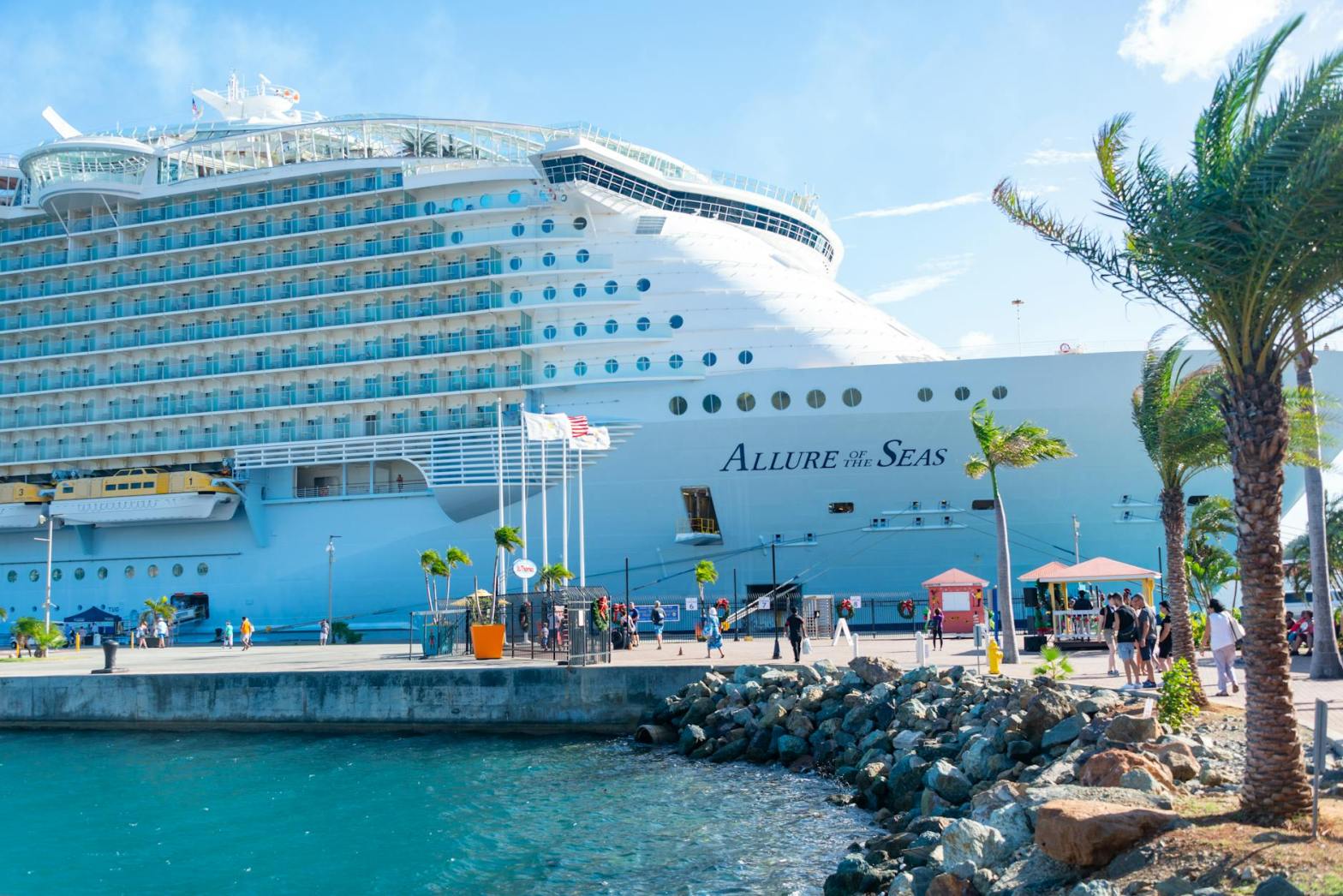
Still on this subject the cruise industry has come in for some flak, especially aimed at the vast ships known as ‘cruisezillas’, some as high as 20 decks: tourists disgorged from them tend to walk around a place but not spend much or any money because everything they need is supplied on board. So they’re not seen as benefiting the local economy. ‘If the industry’s growth does not slow, the biggest ships in 2050 will be eight times larger, in terms of tonnage, than the Titanic – the largest ship on the seas before it sank a century ago, according to the campaign group Transport & Environment (T&E). The group also found that the number of cruise ships has risen 20-fold since 1970. Industry projections suggest about 35 million passengers will travel the seas on cruise ships this year – a 6% increase from pre-pandemic levels which analysts attribute to rising wealth. Research published by JP Morgan in June found that demand for cruises “remains robust” and noted that the cruise industry had moved beyond its core market of baby boomers to increasingly attract millennials’.
It’s a tricky one because the economies of many places depend heavily on tourism but there seems no doubt that it’s gone too far in its current range of formats. It will be difficult to reach a consensus when the industry is so large, its products are in such demand and solutions will need to be cross-border ones. One factor which never seems to be identified is the dubious role of travel writers – every day in the media we see articles and programmes urging us to get to this or that exotic destination before the hordes descend. These writers often (always?) get free trips but are not acting responsibly if the effect is to cause such distress to locals pushed out by inflated tourist numbers.
Finally, Radio 4’s Today programme this morning had a feature about the worrying growth of tourism in the Brecon Beacons, an area of Wales known for the beauty of its scenery and its Dark Skies status. One factor cited (which of course happens everywhere) is the determination of instagrammers to snap selfies in these special destinations and in some places what’s effectively a queue develops. But we must no longer call it Brecon Beacons, because its official name is now the Bannau Brycheiniog National Park. Having discussed the financial aspects of managing such places, the presenter raised the issue of an entrance fee, suggesting, tongue in cheek, that only those able to pronounce this name should be allowed in. That would be one way of managing the hordes!
 Politics and mental health - the missing link?